
Building a Space Engine at Home: Pulsed Plasma Thruster Build Log
I’m building a Pulsed Plasma Thruster from scratch. A PPT is the simplest electric propulsion engine that has actually flown in space — it’s been used since 1964. It doesn’t burn fuel. It sends a kiloamp arc through Teflon, creates plasma, and accelerates it with Lorentz force. The thrust is in micronewtons, but in space there’s no friction. That’s enough.
John D. Clark wrote in Ignition!, his legendary book on rocket propellants:
"Rocket science has been equated with the impossible, but this is a field where the impossible is merely the not-yet-accomplished."
That’s the spirit. A plasma thruster on my desk is not impossible. It’s just not-yet-accomplished.
Why PPT?
Other electric thrusters — Hall-effect, ion, electrospray — can’t be built at home. They need xenon gas, vacuum chambers from day one, or nanofabrication. A PPT’s fuel comes from the hardware store, its energy from an electronics shop, and the first firing happens on your desk.
How it works
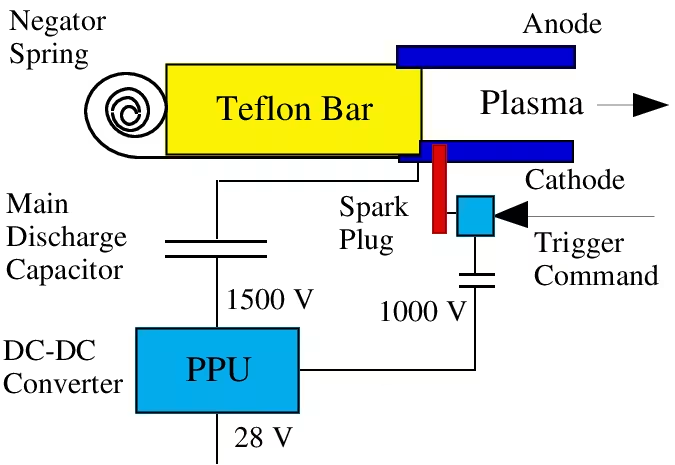
A capacitor charges to 1–2 kV. A trigger spark initiates the main arc. The arc vaporizes Teflon into plasma. The plasma accelerates through its own magnetic field and gets ejected. Newton’s third law pushes the spacecraft the other way. The capacitor recharges. Repeat.
George P. Sutton puts it beautifully in Rocket Propulsion Elements:
"The elegance of electric propulsion lies in trading thrust for efficiency. What you lose in raw force, you gain in the patience of physics."
The roadmap
Phase 1 — Charging Circuit (Week 1)
ZVS driver + flyback transformer to charge the capacitor. Mount the bleeder resistor FIRST. No PPT yet, just power electronics.
Phase 2 — Trigger Circuit (Week 2)
Completely independent from the main line. Mini HV boost, ignition coil, optocoupler, Arduino. Tune until every trigger produces a reliable spark. Misfire rate must drop below 1%.
Phase 3 — PPT Body (Week 3)
Two copper electrodes with a Teflon rod between them, compression spring behind it. Strip line connection from capacitor to electrodes — short, thick, low-inductance copper bus bars with Kapton tape between them.
Phase 4 — First Firing (Week 3–4)
Bring it all together. Test at half voltage first. A successful firing looks like: blue-white flash, a sharp pop, an ablation crater on the Teflon. Record the discharge waveform with an oscilloscope.
Werner von Braun once said:
"Research is what I’m doing when I don’t know what I’m doing."
That’s Phase 4 in a nutshell. You don’t know what will happen. That’s the whole point.
Phase 5 — Optimization (Ongoing)
Gradually increase voltage, sweep trigger delay, adjust electrode gap. Log everything: voltage, peak current, waveform, Teflon mass.
Phase 6 — Vacuum Test (Advanced)
University lab or custom vacuum chamber. Real thrust measurement, specific impulse calculation. This is the project’s final boss.
Phase 7 — CubeSat Integration (Long term)
Miniaturize to 1U form factor. Flight qualification.
Safety
This part is not a joke. A capacitor at 2 kV with 10 µF stores enough energy for cardiac fibrillation. Work with one hand only, keep the other in your pocket. Never touch the circuit while the capacitor is charged. Power off, wait, ground it, verify with a multimeter, then touch. No working alone. HV gloves and goggles are mandatory.
As Richard Feynman put it:
"For a successful technology, reality must take precedence over public relations, for Nature cannot be fooled."
Physics doesn’t care about your enthusiasm. Respect the voltage.
That’s it. Teflon will vaporize, plasma will glow, the oscilloscope will dance. Let’s begin.